
INTRODUCTORY LEVEL COURSE
Find Guitar Scales
for Chord Progressions
using a single Scale Position
Following are seven lessons but first know all the musical notes on the high e string for this simple new method starting with a Box Pentatonic scale of four notes.
The Box Pentatonic scale can shifted up or down the fretboard to the fret with the same letter name as the commencing chord for a piece of music.
More of the scale is later identified by adding two notes by ear inside the Box Pentatonic.
There is a YouTube video of this Short Course at the bottom if preferred.

Lesson 1.
BOX PENTATONIC scales
The name Box is used here to describe scales based on the e and b strings only.
A piece of music usually begins with a Major chord or minor chord and has a melody based on a scale which is a set of seven notes usually that are suitable.
Often the scale will not change throughout a Chord Progression.
The Box Pentatonic scale can be shifted up or down the fretboard to the fret on the high ‘e’ string with the same letter name as the commencing chord.
SEE HERE the Box Pentatonic scale for a piece commencing with an A minor chord.
Notice it extends up the fretboard from the Root Note a on the high e string.

Try playing this along with the song Like A Hurricane by Neil Young.
SEE HERE the relative Box Pentatonic scale for a piece commencing with a C Major chord.
Notice it extends down the fretboard from the Root Note c on the high e string.
The scale shape is the same as the A Minor Box Pentatonic so described here as relative.

Try playing this along with the song Like A Rolling Stone by Bob Dylan.
PRACTISE will be more effective with backing track videos in Members Section after Sign Up.
Lesson 2.
Special BOX PENTATONIC scales
Occasionally a musical piece might commence with a minor chord and its Box Pentatonic scale will encounter a chord that needs a slight modification.
The upper note on the b string is raised by one fret during one of these special Major chords called a Major V chord (Major Fifth), particularly found in Classical or Spanish sounding music.
SEE HERE the slightly modified Box Pentatonic scale for the ‘special’ E Major V chord in a piece with a commencing chord of A minor.
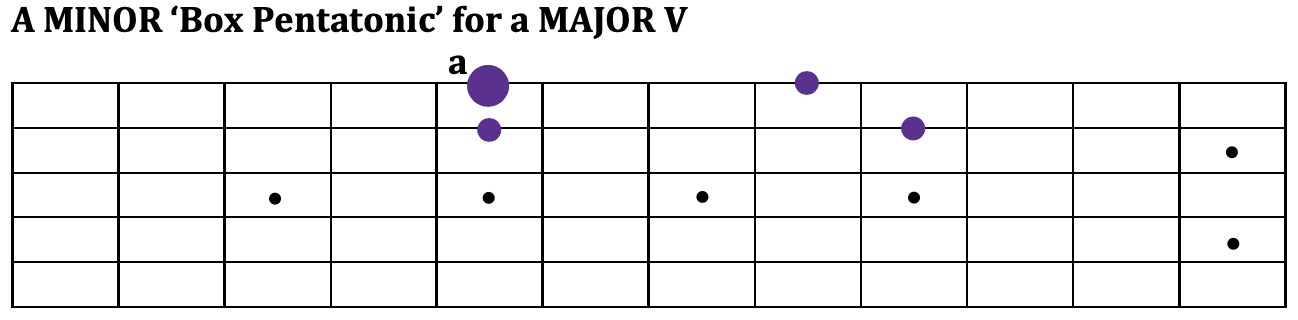
Try this along with House Of The Rising Sun by The Animals which starts with A minor then has an E Major V.
Correspondingly in a piece commencing with a Major chord, its relative Box Pentatonic scale will also need the upper note on the b string raised by one fret during its specialMajor chord called a Major III chord (Major Three) as in the second chord of Creep by Radiohead.
SEE HERE the slightly modified Box Pentatonic scale for the ‘special’ E Major III chord in a piece with a commencing chord of C Major.
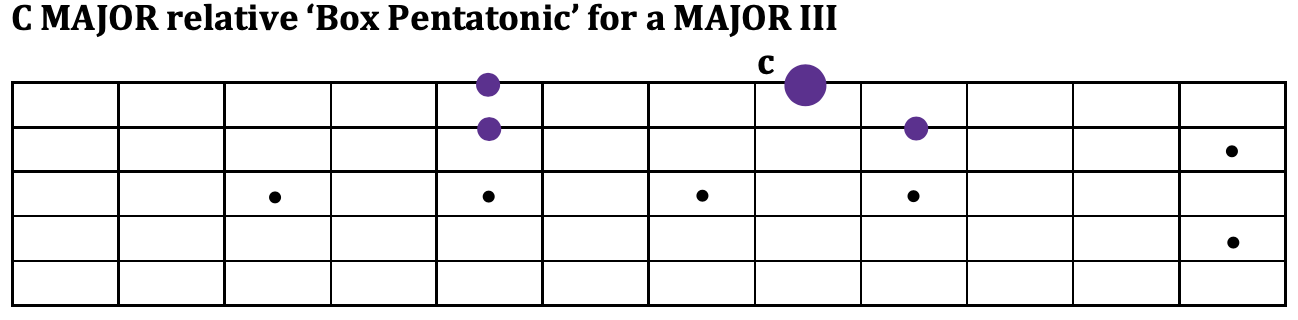
Try this on the chorus of Space Oddity by David Bowie which starts in C Major then goes to an E Major III.
PRACTISE will be more effective with backing track videos in Members Section after Sign Up.
Lesson 3.
LIMBO BOX BASIC scales
The name Limbo is an invented name to describe scales for Major chords that are very special requiring a modified scale that may be ambiguous according to taste.
Encountering a very specialMajor chord becomes obvious if a Box Pentatonic scale encounters a wrong sounding upper note on the estring for one Major Chord, which needs to be raised one fret for the duration.
Thus the scale becomes the Major V Limbo Box Basic (used for a Major chord called Secondary Dominant).
SEE HERE the Major V Limbo Box Basic scale for a ‘very special’ A Major chord if a piece has a C Major commencing chord followed by the A Major chord.

Try it over the intro for Proud Mary by Creedence Clearwater Revival or chorus of Children Of The Revolution by T Rex.
Also be aware that a commencing Major chord can often be very special.
For example a piece commencing with an A Major chord followed by a C Major chord as in the chorus of Are You Gonna Be My Girl by Jet.
And a piece might sometimes have the less common alternative very special Major chord requiring upper notes on both the e and b strings to be raised one fret for the duration, thus becoming the alternative Limbo Box Basic scale.
SEE HERE the Limbo Box Basic scale for the alternative ‘very special’ A Major chord in a piece usually featuring a C Major chord, or even commencing with an alternative ‘very special’ A Major chord followed by a C Major chord.

PRACTISE will be more effective with backing track videos in Members Section after Sign Up.
Lesson 4.
BOX MODE scale
Both the Major scale and Minor scale have seven Notes.
The previous Box Pentatonic scales have the four most important notes and two more notes of the complete scale are easily identified by adding an extra note on each string by ear, to either of the two frets inside the Box.
This is based on The Modes and great ear training too.
The added notes can usually continue during the special Major chords too.
Be aware the added notes inside a scale shape can sometimes change for just one chord which technically means the Key of the piece has changed or modulated.
However some Key Changes will require shifting the scale position.
SEE HERE the three versions of Box Minor Modes from adding extra notes to an A Minor Box Pentatonic scale for a piece commencing with an A minor chord.

Try the A Aeolian over Like A Hurricane by Neil Young.
Try the A Dorian over most of Oye Como Va by Santana.
Try the A Phrygian over a Spanish music style such as the chords of A minor to Bb Major.
SEE HERE the three versions of Box Major Modes from adding extra notes to a C Major relative Box Pentatonic scale for a piece commencing with a C Major chord.

Try the C Ionian over Like A Rolling Stone by Bob Dylan.
Try the C Lydian over the verses of Wish You Were Here by Pink Floyd.
Try the C Mixolydian over Rock And Roll by The Velvet Underground.
PRACTISE will be more effective with backing track videos in Members Section after Sign Up.
Lesson 5.
BOX MAJOR V and III scales
As mentioned in previous lesson, extra notes added on frets inside Box scales can usually continue during the modified Box scales for special Major chords.
SEE HERE the two versions possible for notes added to the modified Box Pentatonic scale during ‘special’ E Major V chords for pieces commencing with an A minor chord.

The A Aeolian version suits the E Major in House Of The Rising Sun by The Animals.
The A Dorian version suits the E Major in Oye Como Va by Santana.
SEE HERE the two versions possible for notes added to the modified Box Pentatonic scale during ‘special’ E MAJOR III chords for pieces commencing with a C Major chord.
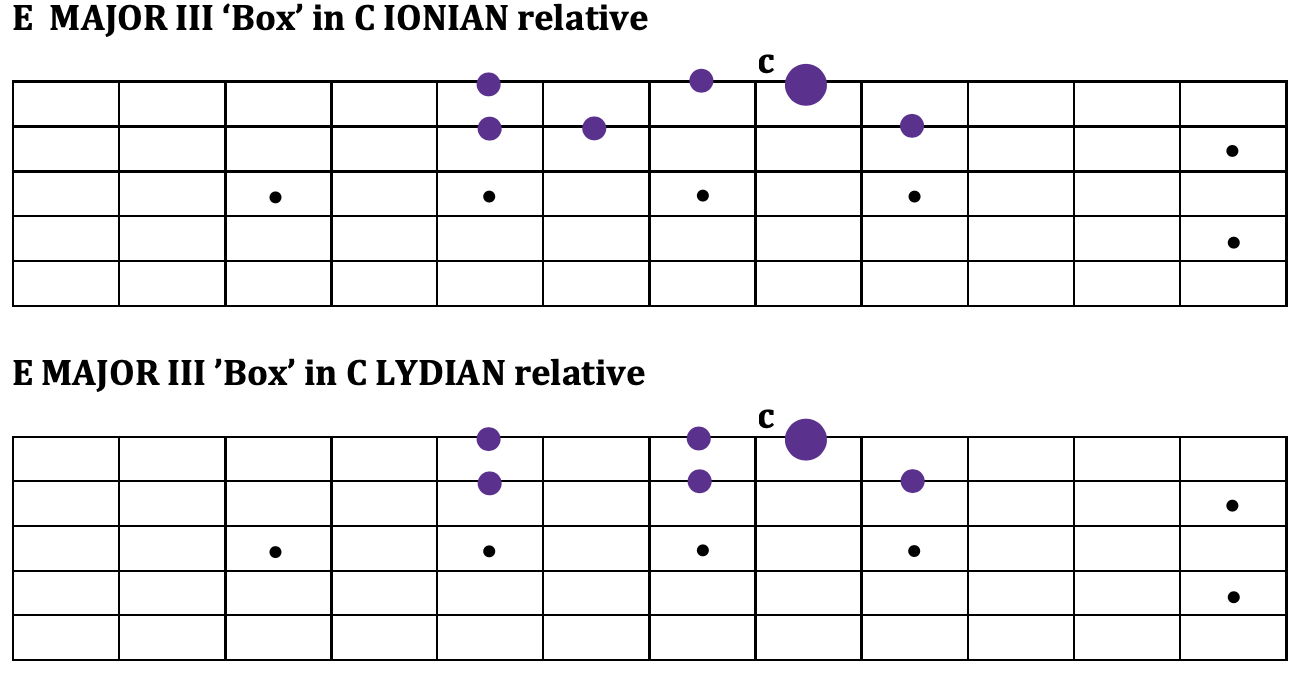
The C Ionian version suits the E Major in the chorus of Space Oddity by David Bowie.
The C Lydian version suits the E Major at end of chorus of I Am The Walrus by The Beatles.
PRACTISE will be more effective with backing track videos in Members Section after Sign Up.
Lesson 6.
LIMBO BOX MODE scales
The name Limbo was invented to describe scales for Major chords that are very special and the correct scales can be ambiguous depending on taste.
They are created by adding extra notes, by trial and error, to the previous Limbo Box Basic scales.
These scale diagrams are the same as conventional Major Modes but this new method does not recommend using them firstly to find the scales for a piece with a commencing Major chord.
SEE HERE the first two versions possible for notes added to the Limbo Box Basic scale for an A Major chord in pieces including or commencing with a ‘very special’ A Major chord, and the alternative ‘very special’ A Major chord.

The A Mixolydian suits an A Major if it follows a C Major chord in Lydian Mode, or vice versa as in the A Major chorus of Are You Gonna Be My Girl by Jet.
The A Ionian suits an A Major 7 if it follows a C Major chord in Lydian Mode or vice versa.
SEE HERE the last two versions possible for notes added to a Limbo Box Basic scale for an A Major chord in pieces including or commencing with a ‘very special’ A Major V or A Major III chord.

The A Aeolian Dominant suits an A Major if it follows a C Major chord in Ionian Mode (or vice versa).
The A Phrygian Dominant suits an A Major if it follows a C Major chord in Mixolydian Mode as in C7 to A7 or vice versa.
PRACTISE will be more effective with backing track videos in Members Section after Sign Up.
Lesson 7.
BLUES BOX PENTATONIC scale
FInally another approach if a piece commences with a very special Major chord.
Guitar players will often play a lead solo with the Blues Pentatonic scale using string bends to correct the wrong sounding notes (but it can sound out of tune with a singer).
SEE HERE the Blues Box Pentatonic scale in A Major with an arrow showing the string bend.
It is very common for Blues music that starts with an A7 chord but often suits Power Chords too.

Try playing it over solo section at end of La Grange by ZZ Top.
Further learning can be achieved with videos of these scales available with paid Membership of USD$15 after Sign Up and also includes downloadable scales sheets.
Private Online Lessons and songwriting mentoring available also.
Examples of a scale demonstration video and backing track video for practice.
A AEOLIAN BOX Mode scale demonstration video.
A AEOLIAN BOX Mode backing track video.
Membership after Sign Up and payment of USD$15 provides access to stream individual scale demonstration videos of all these 17 scales (as listed below) highlighting scale diagrams for the sound and fingering, and the backing track videos for practise, as well as downloadable collections of the scales sheets for easy reference.
Box Pentatonic for A Minor and C Major (relative)
Box Pentatonic Major V/III for E Major V and E Major III
Limbo Box Basic for A Major V and A Major
Box Minor Modes for A Aeolian, A Dorian and A Phrygian
Box Major Modes for C Ionian, C Lydian and C Mixolydian
Limbo Box Major for A Mixolydian and A Ionian
Limbo Box Major V/III for A Aeolian Dominant and A Phrygian Dominant
Box Pentatonic for Blues in A Major