
About
YOUR TUTOR
Peter Koppes -
Founding guitarist formerly with the Australian international touring and recording prog/pop band The Church, renowned for their innovative guitar style as well as the alternative hit song ‘Under The Milky Way’.
Also a Diploma Of Music level teacher at Australian colleges and guest lectured at Queensland University of Technology.
Websites: www.peterkoppes.com thechurchband.com
Photo credit: Malcolm Viles
THE COURSES
Traditionally there has been two approaches for guitarists to find Scales for creating melodies over a musical piece:
- either identifying the Key or Root Scale
- or identifying the Modes for each chord used for Jazz and by Bass guitarists
Both require extensive knowledge of music theory.
But now the INTRODUCTORY LEVEL COURSE overcomes this by using:
- a simple Box method (based on Modes)
- beginning with an easy Scale Shape of four notes on the e and b strings only
- then one note is added by ear to each string on either of two frets inside the Box to identify more of the complete Scale or Mode of the musical piece
- just the first chord is needed to locate the scale position on the fretboard
Know that the Scale or Mode usually remains unchanged throughout a piece except for any special Major chords and Key Changes requiring a slight modification.
The INTERMEDIATE LEVEL COURSEuses the g, b and e strings to complete a full octave of the Scales/Modes and the following ‘special’ Major chords:
- Secondary Dominant
- Borrowed
- Major V and Major III.
And included are revolutionary Scales for Diminished and Augmented chords, identified as Altered Modes with their seven Notes based on Stacked Thirds and No Consecutive Semitones.
The ADVANCED LEVEL COURSE extends all Scales and Modes across six strings plus eight essential Blues/Jazz Scales including BeBop.
Also featuring an exclusive Altered Mode for the Dominant 7#9 Hendrix Chord.
THE MODES
The course foundation is based on Modal theory which can be visualised using this unique illustration of a house as a metaphor.

THE HOUSE OF MODES ILLUSTRATION
This illustration of a House represents the seven chords in the Key of C Major or its relative A minor as their seven Modes. These two Root chords are the rooms on the ground floor.
Know that a piece of music can commence in any chord room of the house or even other houses.
Modes are just scales starting on different notes of the Major or Minor scale and are different rooms in the house.
On guitar, a Mode is the easiest way to find the correct Scale for a piece rather than figuring out the Root Key scale.
There are three Major chords, cheery sounding, on the sunny left side of the house.
There are three Minor chords, somber sounding, on the cloudy right side.
The seventh Half Diminished chord is the rare and darker sounding Minor Flat 5th chord of the attic.
Two of the Minor chord rooms have a light switch to artificially brighten the room to become a special Major chord called a Major V or Major III and represented by light rays outside the window because a changed note in the Mode does not belong in the house. And sometimes this can be the first chord in a piece.
The first chord could even be from the top Major chord room in another house and called a Secondary Dominant.
All possible extra notes in Blues/Jazz scales are represented as leaves around the treehouse room outside that is alongside the Mixolydian room at the third level of the sunny side (a slightly ambiguous Major chord called a Dominant).
Diminished chords are represented by the storm cellar alongside the house due to some notes in the scale that do not belong in the house.
Augmented chords are represented by the fire ladder on the front of the house for the same reason.
This house exists in a neighbourhood of twelve houses illustrated below, representing all the possible Root Keys in music, and a spiral slide representing notes moving up or down in pitch called Portamento.
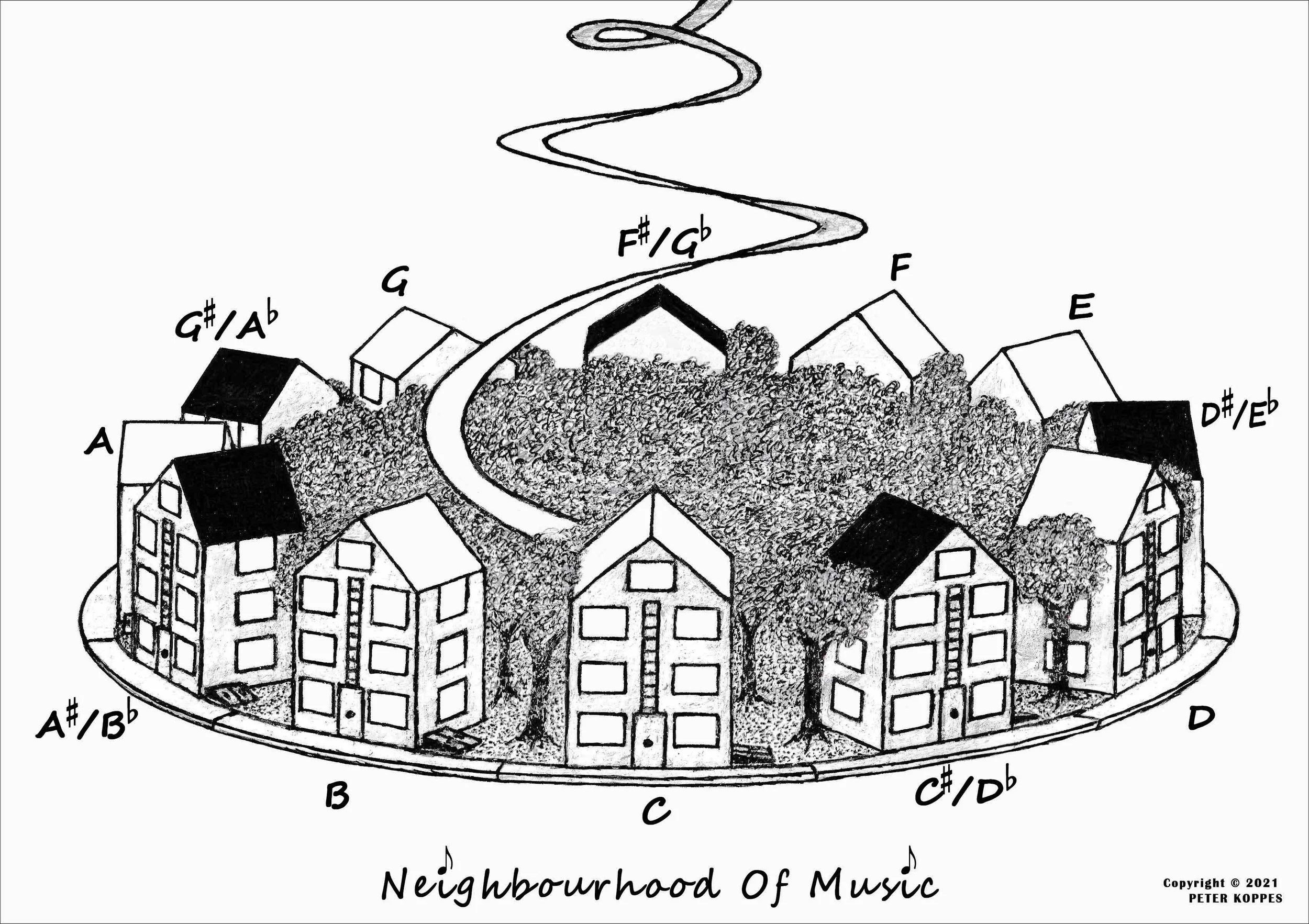
Neighbourhood Of Modes illustration